

.png)
A Day at the EAIA Conference – Genesee Country Village & Museum
Updated: Jun 7, 2025

Last Thursday, I attended the Early American Industries Association (EAIA) Annual Conference in Rochester, NY, specifically for the Genesee Country Village & Museum day. The conference draws together people working across historic trades and material culture, from tool collectors to blacksmiths, conservators, and museum professionals. It’s a more practice-based community than many heritage conferences I’ve attended, which showed throughout the day.

Genesee Country Village & Museum is a living history site organized into three interpretive zones: the Pioneer Settlement, the Center Village, and the Gaslight District. Each area is populated with relocated or reconstructed buildings representing different stages of 19th-century life in western New York. What makes the museum truly special is its origin story. In the 1960s, conservation-minded founder John L. Wehle began rescuing endangered historic buildings across the region. One by one, they were carefully moved and reassembled on this site, creating an environment where history isn’t just displayed, it’s lived and experienced.
During my visit, I explored several of these remarkable structures. Here’s a closer look at a few that stood out...

In the Pioneer Settlement, I walked through log homes, early workshops, and utilitarian farm structures that reflect a more self-sufficient, frontier lifestyle. The interpretation in this area was hands-on and unpolished in a good way, it felt focused on giving visitors a working sense of the skills needed to build and survive during that time.

The Center Village represents the mid-1800s, with more refined architecture, period storefronts, and active trades like tin smithing and printing. It’s the kind of setting where you can see the evolution of material culture, not just in buildings, but in the way people lived and worked.

Inside the shop are bolts of cloth, paper patterns, and hand tools that tell the story of everyday craftsmanship in a growing village.
The Flint Pottery building was reconstructed to represent mid‑19th century pottery, originally tied to Morganville and Flint Hill from around 1845. The workshop showcases traditional 19th-century ceramics, where skilled potters shape clay into jugs, crocks, and household wares using a foot-powered wheel and open kiln. The wood‑fired kiln is one of the only 19th‑century style salt‑firing kilns still operating in the northeastern U.S.
The L. Tyler Boot& Shoe Shop, 1850s, represents a typical mid-19th century cobbler’s workshop, where custom boots and shoes were handmade using leather, lasts, and classic hand tools.
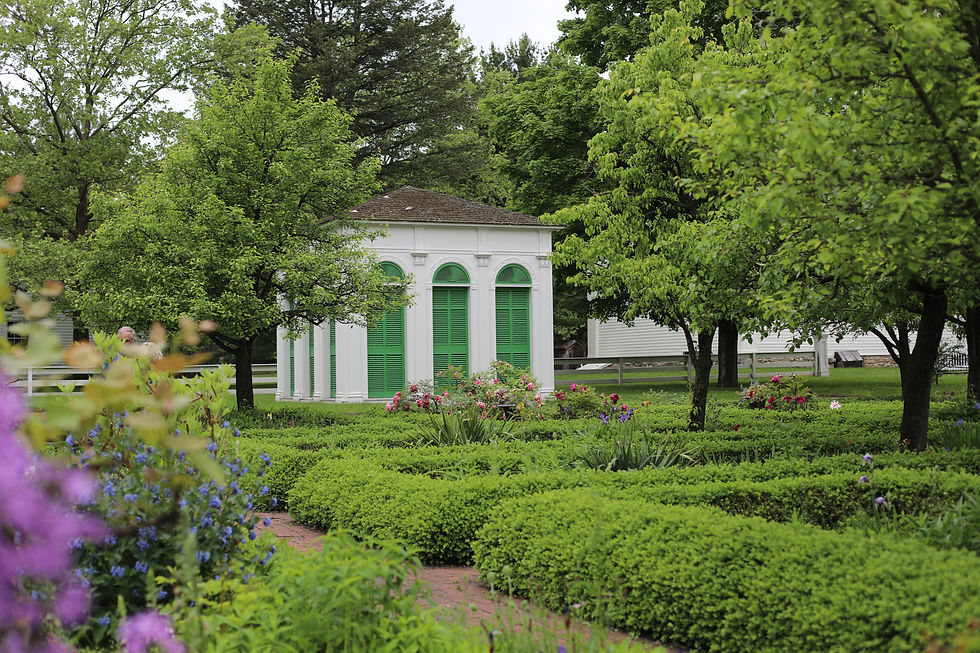
Imagine purchasing the Livingston-Backus House for $10,000! That’s exactly what Dr. Frederick Backus did in 1838 when he bought this grand mansion in Rochester, one of the city’s earliest and most elegant homes, originally built in 1827 by entrepreneur James Livingston. Backus soon transformed the home with elegant Greek Revival details.
Decades later, it became a prestigious girls’ school, serving generations of students. When the house faced demolition in the 1950s, a local benefactor intervened, carefully dismantling and storing it until its reconstruction at the Village in 1970, where its legacy continues today.

Finally, the Gaslight District steps into the late 19th century, with taller brick buildings, organized streets, and the visual shift that comes with industrialization. The layers of history across the three sections help situate trades and techniques within a wider context of cultural and economic change
The Hamilton House, 1825, is an example of refined Federal-style architecture once located in Campbell, New York. In one of the photos here, you’ll see the Hamilton House being moved, beam by beam, a process repeated for dozens of structures on the site.
The house was decorated throughout with beautiful wallpapers typical of the 1830s, featuring bold patterns and rich colors that reflected the growing influence of machine printing and the era’s fascination with symmetry and classical motifs.
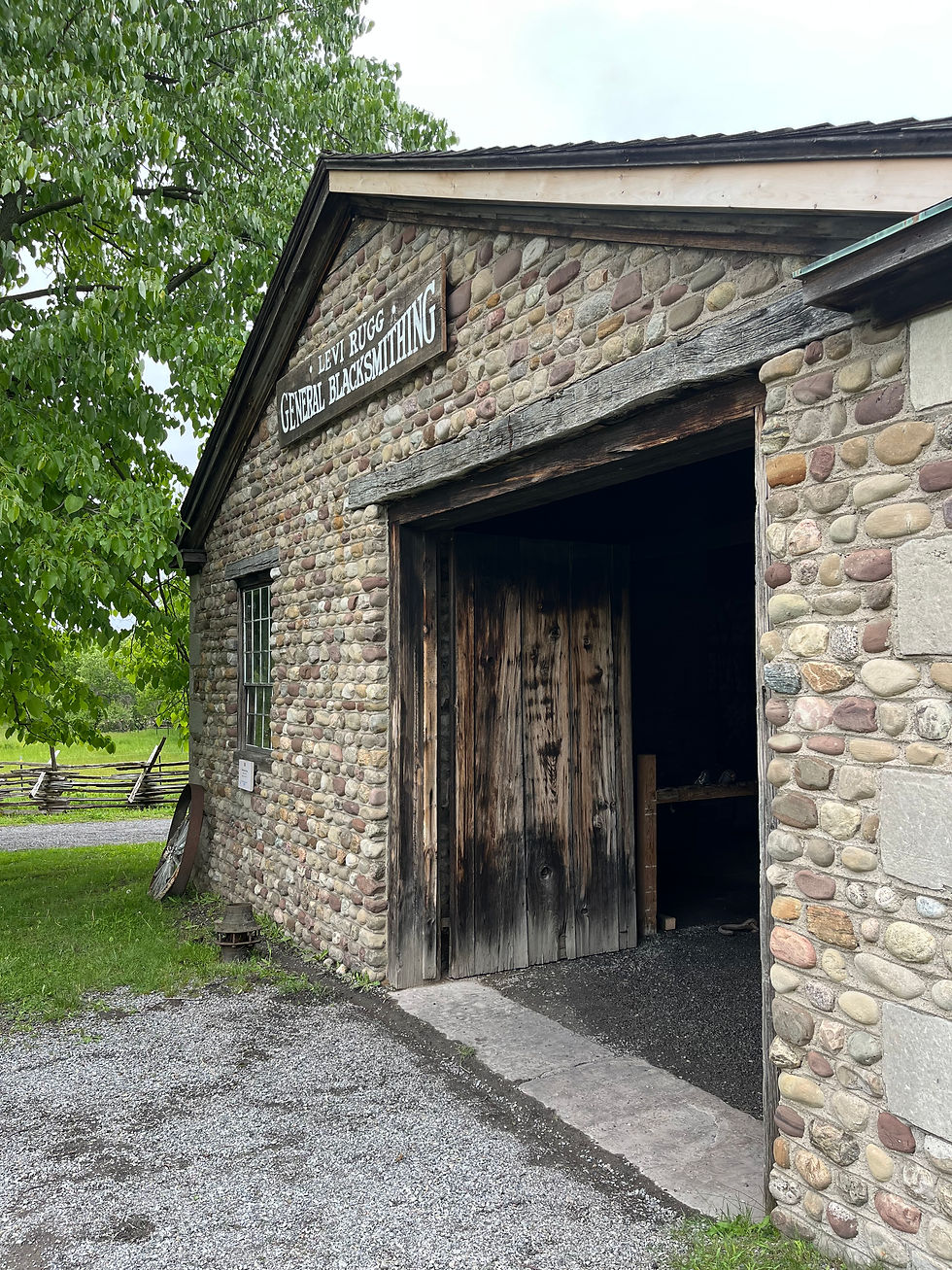
One of the most impactful parts of the day was a blacksmithing demonstration I attended in the forge. It wasn’t just the demonstration itself, it was who was there. The forge was filled with practicing blacksmiths and metalsmiths from across New York State. Many knew one another from previous conferences or through work at other heritage sites.
As the demonstrator worked on forging an axe head, the group watched closely, exchanging ideas, tips, and comparisons from their own experiences. I didn’t participate in the conversation; I just listened, which was incredibly valuable. I overheard discussions about the design of canal gate joints, region-specific forging techniques, and the kinds of tools being used in other historical settings. It was a technical conversation, grounded in experience. The sense of shared knowledge and mutual respect in the room was clear, and it struck me how much is learned in these informal moments.

What stood out most was how different this felt from the larger conferences that tend to focus more on national policy and academic research. While those have their place, the conversations often circle around the same systemic challenges without arriving at practical outcomes. Here, the focus was narrower, but deeper. These were real people, with real skills, invested in maintaining and passing on trades knowledge. That kind of community, built on work, not just ideas, is what sustains the field.


Comments